
Great hospitality is never separate from its surroundings.
The best menus do more than feed a room. They respond to where they are, who they are serving, what is in season and what kind of energy the event needs to create. A menu in Cannes should not feel the same as a menu in Davos. A coastal summer event should not carry the same rhythm as a winter gathering in the mountains. Every destination brings its own ingredients, suppliers, pace, atmosphere and expectations.
At LiquidChefs, we do not simply arrive, set up and serve. We build experiences around place.
That starts with understanding the location properly. Before the first dish is finalised, we look at what the destination can offer, which local producers are doing interesting work, what ingredients are at their best, and how the menu can feel connected to the environment around it. This is where locality becomes more than a sourcing choice. It becomes part of the experience itself.
Every location has its own rhythm.
Cannes carries a different kind of energy to Davos. One is shaped by the coast, the Mediterranean light, Riviera produce and long days of movement between venues, meetings and evening events. The other is shaped by altitude, winter, precision, warmth and the need to create moments of comfort and connection in a very different setting.
A strong menu understands those differences.
In Cannes, that might mean building around local produce, regional wines, fresh seafood, Riviera suppliers, Provençal flavours and the kind of food that feels bright, generous and suited to the pace of the event. In Davos, the menu may need to work harder to create warmth, substance and a sense of ease within a high-pressure global environment.
The point is not to force a theme. It is to listen to the place and let the menu respond.
When hospitality is built this way, the food feels more natural. Guests may not always be able to explain why the experience feels right, but they can feel when the details belong together.
Local sourcing is often spoken about as a sustainability measure, but for LiquidChefs, it is also a quality measure and a relationship-building practice.
Working with local suppliers gives each event greater depth. It connects the menu to the people who know the region best: the growers, fishmongers, bakers, brewers, roasters, winemakers, farmers and makers whose work brings the destination to life.
These partnerships are not built through a quick order sheet. They are built through trust, consistency and shared standards.
A supplier who understands the pace of a live event is not just delivering ingredients. They are helping protect the quality of the experience. A fishmonger who knows exactly what is freshest, a grower who understands seasonality, a baker who can deliver at the right time, a winemaker who carries the character of the region — each one becomes part of the wider hospitality system.
This is why microcommunities matter.
Behind every global event is a local network making it possible. The event may attract international guests, brands and teams, but the experience is often carried by people working close to the ground. When those relationships are respected and nurtured, the result is stronger, more responsive and more human.
Seasonality is one of the simplest ways to make a menu feel grounded.
When ingredients are chosen because they are at their best, the food naturally carries more flavour, freshness and purpose. Seasonal thinking also encourages better decision-making. It asks the kitchen to work with what the destination can genuinely offer, rather than forcing ingredients into a menu because they exist somewhere else.
For LiquidChefs, this is where creativity and responsibility meet.
A seasonal menu can still feel premium, refined and generous. In fact, it often feels more so, because it has integrity. The choices make sense. The ingredients belong. The dishes feel connected to the moment, not detached from it.
This is especially important in international event catering, where scale and pressure can make standardisation tempting. A location-led approach requires more thought, but it creates a better guest experience because it feels considered from source to service.
Sustainability in hospitality cannot be reduced to what happens at the end of an event.
Recycling matters, but it is only one part of a much bigger picture. True sustainability begins much earlier, with the inputs: what is ordered, where it comes from, how far it has travelled, how it is stored, how it is prepared, how much is used, what can be repurposed and what happens to what remains.
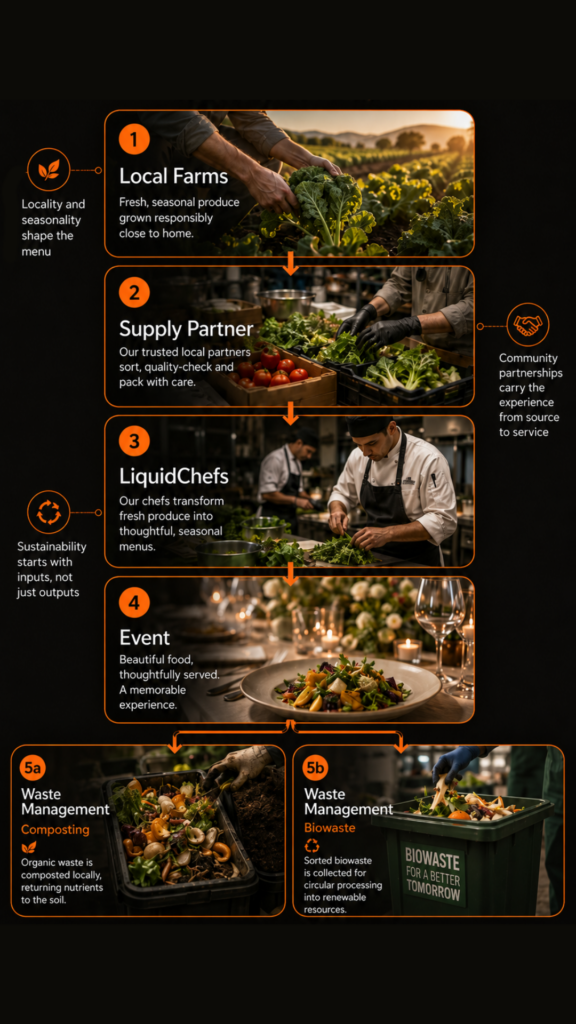
For LiquidChefs, sustainability is about managing the full journey from source to service.
That includes building menus around local availability, reducing unnecessary transport, ordering with care, using ingredients thoughtfully and working with partners who can help close the loop once service is complete. It is a practical mindset as much as a value statement.
In Cannes, this can mean working with local waste partners and circular systems such as composting, where suitable organic waste is redirected back into the local environment rather than treated as an afterthought. In Davos, where the setting and infrastructure are different, the approach may involve biowaste channels and local systems that make sense for that destination.
The goal is not to apply one sustainability model everywhere. The goal is to understand what each place can support, then build the most responsible system around it.
A culinary experience is shaped by hundreds of decisions most guests never see.
The supplier selected. The delivery window confirmed. The ingredient chosen because it is in season. The dish adjusted because the weather has shifted. The portioning calculated to reduce unnecessary surplus. The staff meal planned with care. The leftover ingredient given a second life. The organic waste redirected into a system that serves the local community.
None of these decisions exist in isolation.
Together, they create the standard of the event. They influence how the menu tastes, how the team moves, how much waste is produced and how connected the experience feels to the place around it.
This is where LiquidChefs’ approach becomes more than catering. It becomes a way of building hospitality ecosystems around each destination.
When people attend a global event, they often remember the atmosphere as much as the food itself.
They remember whether the experience felt effortless, considered and alive. They remember the warmth of the room, the pace of service, the quality of the ingredients and the small details that made everything feel properly held.
Local communities help create that feeling.
They bring the produce, the knowledge, the craft, the relationships and the systems that allow a destination to show up through the menu. They make the experience more specific, more sustainable and more grounded.
For LiquidChefs, building around place means recognising that the best events are never delivered by one team alone. They are shaped by a wider network of people who care about their work and understand the role they play in the final experience.
A menu with a sense of place does not need to announce itself loudly.
It is felt in the freshness of the produce, the relevance of the flavours, the way the dishes suit the setting and the confidence that comes from working with trusted local partners. It is felt in the way waste is considered before it becomes waste, and in the way each part of the process is connected to something larger than the plate.
This is how LiquidChefs builds culinary experiences across destinations.
Not by arriving with a fixed formula, but by paying attention. To the season. To the suppliers. To the community. To the rhythm of the event. To the systems that carry the experience from source to service and beyond.
Because great hospitality does not happen in isolation.
It is rooted in place, shaped by people and carried through every decision, from the first ingredient sourced to the final waste stream redirected.